
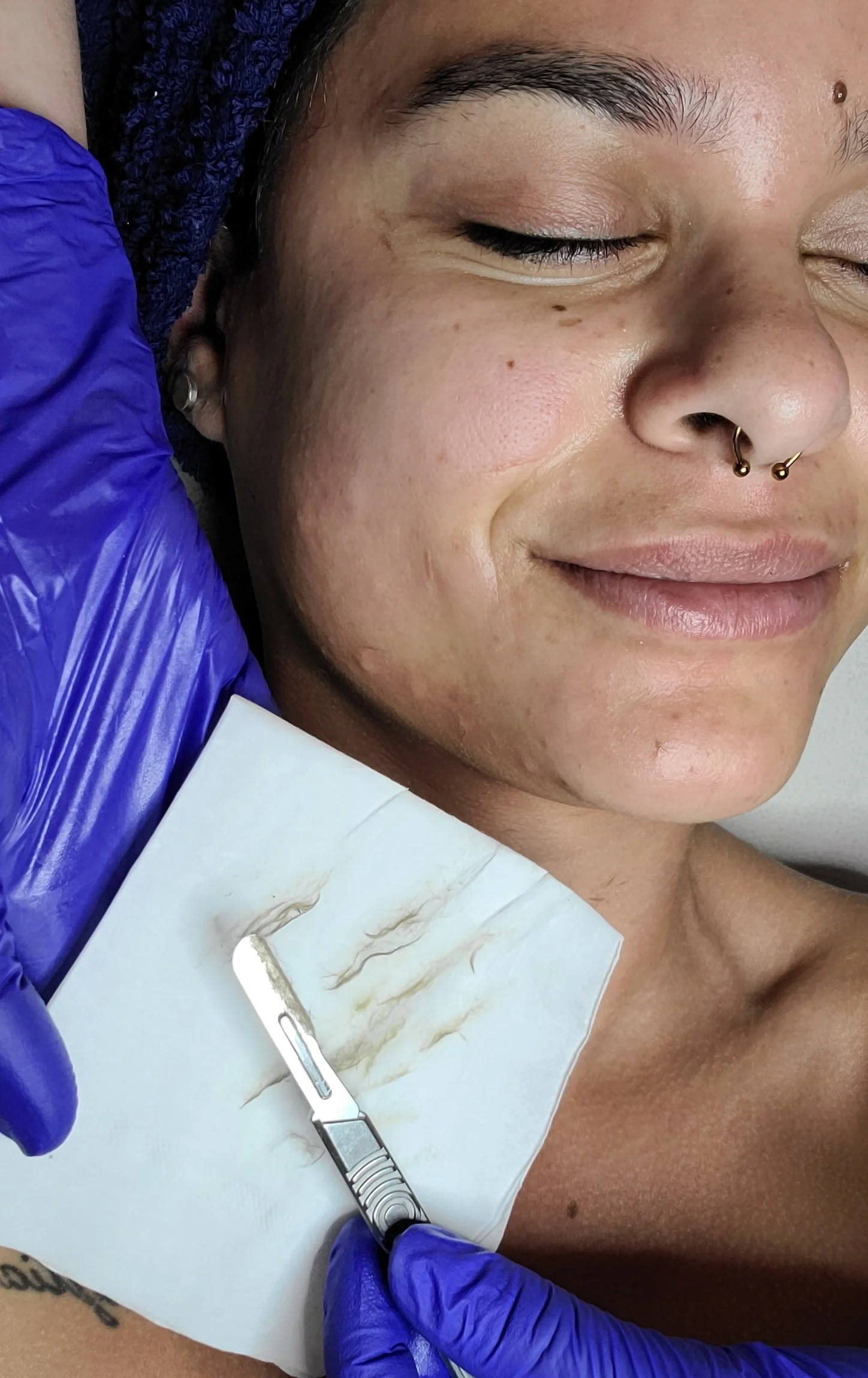
DERMAPLANING - What, How, Why, When
What is Dermaplaning?
Dermaplaning is a cosmetic procedure that uses a surgical blade to manually exfoliate the surface of the skin to remove the dead top layer of old skin cells and vellus hair or “peach fuzz”. It is also sometimes referred to as micro-planing or blading. The aim is to make the surface of your skin smooth, more youthful, and GLOWING. It's also a great tool for prepping the skin by removing tough outer layers of skin barriers prior to performing deeper treatments such as infusions, or peels. It creates a perfect canvas for your makeup application, and it gives the rest of your holistic skincare products a better chance to penetrate to the deeper layers of our skin.
Who is Dermaplaning good for?
Dermaplaning can be performed on many different skin types, and can benefit many different skin conditions. Dermaplaning is perfect for people with dull, dry or textured skin, oily skin types, sun damaged, peach fuzz, and fine lines. It’s also a great option when doing post-acne scar treatments as it helps to reduce the appearance of deeper acne scars and balance the complexion.
Who is Dermaplaning NOT good for?
Dermaplaning is not recommended for anyone with sun burnt skin or active rosacea flare up, active eczema or psoriasis, inflamed skin, sensitive and sensitized skin, or active pustule or cystic acne. We avoid this treatment for these skin types because it could potentially further irritate the condition, or spread the related bacteria to other parts of the face and neck.
The Procedure.
During a Dermaplaning facial you should not feel any pain – Our customised Dermaplaning facial always begins just like any other facial, with a really good cleanse, then exfoliation, and any extractions where necessary. You never want to dermaplane over unwashed dirty skin as we are opening up the pores and exposing it, making it easy for dirt to get inside and cause infection and/or acne breakouts. A pre-cleansing step is very important before performing dermaplaning. Next, your provider will take out a fresh, one-use only surgical blade and place it on the skin at a 45° angle. Applying gentle pressure, we are able to shave, or remove, the top layer of dead skin cells from the surface of your skin. After the dermaplaning procedure, your skin care provider will apply relative serums, and most importantly SUNSCREEN that can be worn for the rest of the day to ENSURE your fresh new skin is protected from any UV damage. This facial treatment can take anywhere from 20 minutes - up to an hour, depending on how complex the facial portion is and if you’re adding on things such as peels or infusions. Once you’re home at the end of your evening, you’ll want to wash your face with something gentle and apply your night cream. DO NOT exfoliate your skin the first few nights after dermaplaning. At this point also do not apply anything too active, or anything that your esthetician has not advised you to use directly after treatment. After a treatment such as this one, you will need to be EXTRA careful with sun exposure. That means wearing your sunscreen every-day. But you’re supposed to be wearing your sunscreen every day anyways! After a treatment such as this, your skin is more sensitive to UV light because it no longer has that hard dry layer that helps protect it. Therefore, making you more susceptible to DNA damage, signs of aging such as wrinkles and sunspots, as well as even skin cancer. Remember folks, the sun damage we see on our skin is not from that one terrible day at the beach where are you laid out too long and got burnt. It is from YEARS of accumulation over time out in the sun.
Commonly asked questions.
Q: Will my hairs grow back thicker after dermaplaning? A: No. The hairs on your face are referred to as vellus hair and is unable to turn into terminal hair, like the kind that grows on our head or legs. In other words, your wispy peach fuzz hair is not physically able to turn into thick stubbly facial hair.
Q: Is there downtime? A: No. There is no downtime to this facial, which contributes to why it’s such a great option. You could have it done on your lunch-break. I advise not to put a lot of makeup on it afterwards, and if you have to put makeup on we prefer it to be a clean brand, talc-free, such as the Jane Iredale Mineral Makeup line, but try to give it a day. Avoid hot tub’s, saunas or pools and going to the gym right after. The skin is very fresh and open so we don’t want any dirt, sweat, or bacteria to enter this way for minimum 24 hours or so. Afterwards your skin should just look fresh and glowing, with a slightly pink oxygenated hue.
Q: Does it hurt? A: No, Dermaplaning should not hurt at all as you’re not going passed the top layer of mostly dead cells and hair. It is like shaving with a very sharp surgical blade, therefore you should just feel a glide across your skin. If you do experience any pain during a procedure, please voice any concerns to your provider immediately.
Q: How often can I get Dermaplaning done? A: You can get this facial procedure done as often as every 3 to 4 weeks, so monthly. You can also get them bi-monthly, seasonally, annually, or just when you feel like you need a fresh start and a blank canvas. It’s the perfect treatment to do a few days before an event as it will give you a fresh, glowy look, and your makeup will go on so smooth afterwards!
If you have any questions, please feel free to reach out and book an appointment with one of our skin professionals at The Natural Art Of Skin Care. Call Kyndle at the front desk and she’d be more than happy to answer your questions over the phone or direct them accordingly.
See you at the Spa!
Rachel Lamont | Owner & Holistic Medical Esthetician
of The Natural Art of Skin Care

Personal Lubricants - The Bad , The Good, and The Delicious.
The topic of choice this February is... PERSONAL LUUUBRICANTS.
Many of us have used them, if you haven’t, congratulations! You and your partner are sexually hydrated! Some of us use personal lubricants in the bedroom for a more enjoyable experience when things aren’t quite as moist. But there are so many different types of lubricants out there, it’s hard to know what may be good for you, and what might not! That’s where I think this guide will come in handy and help give you some clarity this upcoming Valentine’s Day. 💖
When you’re looking to spice things up, go a little longer, or add a little deliciousness to your bedroom routine… we recommend using natural things with organic ingredients that will provide a nice slip without throwing off your inside ecosystem - products such as the Giddy Yoyo RAW LOVE BUTTER! 😍 Organic, Vegan, & Cruelty Free, this full body EDIBLE moisturizer melts effortlessly with the warmth of your body, and nourishes and hydrates the skin, and also smells and tastes like chocolate, making it a perfect pairing for Valentines Day.
Check out the full ingredient listing of this irresistibly sweet smelling, cocoa, vanilla bean flavoured, coconut oil, slippery goodness…
The topic of choice this February is... PERSONAL LUUUBRICANTS!
*WARNING - Using oil-based lubricants can compromise the integrity of a condom. The Giddy Yoyo RAW LOVE BUTTER featured in this article is oil-based.
Many of us have used them, if you haven’t, congratulations! You and your partner are sexually hydrated! Some of us use personal lubricants in the bedroom for a more enjoyable experience when things aren’t quite as moist. But there are so many different types of lubricants out there, it’s hard to know what may be good for you, and what might not! That’s where I think this guide will come in handy and help give you some clarity this upcoming Valentine’s Day. 💖
Firstly, let’s talk about the Vagina for a second - one of woman’s most wonderful gifts from God. A highly complex ecosystem of fresh flesh, and good moisture. Within the walls of us are many delicate mucous membranes that require a certain pH to be happy and function optimally. A healthy vaginal pH level for a woman in her reproductive years is 4.0 to 4.5 acidic. Your average non-natural lubricant can actually raise the pH of your Vagina which will disrupt your vaginal flora, causing things like an over-growth of bacteria like we see in BV.
Found in some lubricants and MANY cosmetic products alike, are P A R A B E N S. Not only are they incredibly irritating to the skin cells, they are also oestrogenic which means they cause your body to produce estrogen. Parabens can be absorbed and act like the hormone estrogen in the body and disrupt the normal function of our hormone systems, potentially turning on the growth of hormone-receptor-positive breast cancers, and also affecting male and female reproductive system functions, reproductive development, fertility, and birth outcomes. 👎
Below I have listed some other ingredients commonly found in leading lube brands such as KY Jelly, or Durex. *Notice how most of the ingredients listed are difficult to pronounce, or you may not know what they are or why they’re in there. Look out for these on the label!
Hydroxyethylcellulose - is used in this product as an emulsion, and a viscosity increasing agent. Most of these ingredients themselves are preservatives, and in the world of holistic skincare we know that preservatives cause irritation to our skin and break down our body’s own natural ability to turn over healthy cells and produce a natural, healthy amount of oil. Because of the way in which personal lubricants are used – inside and intimate places – our sensitive mucous membranes may be affected by these.
Gluconolactone – used as an antimicrobial in drug store lubricant jellys, this alpha hydroxyl acid (probably synthetically derived) can also exfoliate the skin as it’s related to an AHA or BHA... but why do we need to put something like this in our “down there”?? Well, it’s usually in the product to help stabilize it, but our bodies don’t know how to properly process out toxin such as these, and they are absorbed.
Chlorhexidine – acts like an alcohol and is known to kill bacteria, this synthetic ingredient can also be found in surfactants, the sanitization of dentist tools, oral mouth rinses, and clinical grade gingivitis fighting solutions.. It is also widely known to greatly cause allergic reactions, and irritations to the skin, especially with frequent use. This could contribute to why so many people say that they experience rashing when using personal lubricants. We must protect our healthy cells at all costs, especially within our delicate mucous membranes!
Sodium Hydroxide – (an inorganic compound also known as lye or caustic soda-harsh), that breaks down proteins at ordinary temperatures. When proteins are broken down in the skin, we have a less effective protective layer, and are therefore more susceptible to skin burns, irritations, or rashing. Sodium hydroxide is used in many different products, including the manufacture of pulp and paper, textiles, soaps and detergents, and is a main ingredient in DRAIN CLEANER… WHY ON EARTH would we need this in our sexy time tools?!
Methylparaben - Used as an anti-fungal agent, can also be found in food and cosmetic preservatives. The Environmental Working Group (EWG) lists methylparaben as being a low to moderate health hazard in regards to allergic reactions, especially when the product is used frequently.
Glycerin — also known as glycerol or glycerine — is a sugar alcohol compound. While glycerin can act as food for some types of healthy vaginal flora, it can also act as food for yeast strains, most notably candida albicans. An average lubricant contains more than 20% glycerin, making it likely to cause mucosal irritation, where water moves out of the cells in your vaginal walls to a semi-permeable membrane to equalise pressure, by the process of osmosis.
Lubricants and FERTILITY – If you’re fertile and are looking to pro-create, you should know that due to its syrupy and viscous texture, certain lubricants can reduce the ability for sperm to swim throughout the vagina and make its way up to a woman’s Cervix. The result is that sperm end up dying in the acidic environment of the vagina before they can reach the uterus. If you’re like me, and many women looking to conceive right now, you will want to steer clear of these types of elements as they will work against you in the race to baby town.
If you’re NOT looking to re-produce, and maybe you’re using a spermicidal lubricant, be aware, Nonoxynol-9 is the active ingredient used in most of these types of lubes, and it’s been found to be damaging to vaginal tissue, causing severe irritation and even inside cuts... This would greatly increase the risk of an STI transmission infection, and wouldn’t feel very good whatsoever!
SO, this brings us to what you CAN use when playing between the sheets.
When you’re looking to spice things up, go a little longer, or add a little deliciousness to your bedroom routine… we recommend using natural things with organic ingredients that will provide a nice slip without throwing off your inside ecosystem - products such as the Giddy Yoyo RAW LOVE BUTTER! 😍 Organic, Vegan, & Cruelty Free, this full body EDIBLE moisturizer melts effortlessly with the warmth of your body, and nourishes and hydrates the skin, and also smells and tastes like chocolate, making it a perfect pairing for Valentines Day.
Check out the full ingredient listing of this irresistibly sweet smelling, cocoa, vanilla bean flavoured, coconut oil, slippery goodness;
Organic Cacao Butter – Giddy Yoyo’s cacao butter is made from fully fermented lightly-roasted fine flavour Ecuadorian Arriba criollo non-hybrid cacao – a real ingredient. We like that. Cacao Butter can help improve blood flow, and you can also add it to your morning coffee or bake with it! Multi-purpose lube.
Organic Coconut Oil – We all know and love COCONUT OIL. With its many wonderful benefits and healing properties, it’s ability to heal wounds, its an anti-inflammatory, anti-microbial, anti-bacterial, and it makes for a great lubricant when you’re feeling dry! You may have this option in your fridge or cupboard already, so reach for this instead of taking a drive to the drug store the next time you’re in need. Be careful with how often you have coconut oil down there because this can somewhat upset the delicate balance of our flora when used consistently.
Organic “Ice Pressed” Olive Oil - Rallis still farms their olives the old-fashioned way. This means with no chemical pesticides, no sprays, and no fancy machinery. They work to maintain a high antioxidant content in their olive oils, there are several significant factors that can impact this antioxidant value: a late harvest, mechanical agitation, slow to press, high heat, and filtering. This brand bypasses these common trappings to ensure its olive oil maintains the highest energetic value, and its status as a raw superfood!
Ground Vanilla Beans – Interesting fact; Sustainably FARMED, each Vanilla BEAN is the hand-pollinated fruit of the Vanilla Tahitensis orchid which blossoms open for just a few hours, only ONE day a year! The beans need up to ten months to mature, then they are hand-picked and require an additional six months to cure. Wow! Now THAT’S how your ingredients should be sourced, by farming, organically grown, or naturally sourced.
Vanilla Beans are RICH in antioxidants, which are great for us because they help repair your body at the molecular level and fight off free radical damage.
Now that you’ve read those deliciously simple ingredients, wanna know what else you can use the Love Butter for? Baby diaper bum protector, hair oil, makeup remover, massage lotion, low SPF sunscreen**, and relief from burns, rashes, laser treatments, eczema, dryness, etc. And if none of that appeals to you, then add it to your coffee or your favourite dessert recipe instead.
Available in 2 sizes, depending on your usage, and trust me, you’ll probably be using it a lot. 😉
Small Jar, 100 ml = $24.00
Large Jar, 200 ml = $33.00
Pick yours up at the spa, or order online – mention that you read this article and we’ll give you 10% OFF the Giddy Yoyo Raw Love Butter! Just in time for Valentines Day.
Enjoy, Lovers. 💕
Kyndle Doolan | Spa Director at The Natural Art of Skin Care

Melasma + Hyper-pigmentation Damage, and How You Can Fix It!
Over the years I’ve had many clients come into my spa asking how to combat uneven pigmentation damage in the skin. So, I decided to put this little article together for anyone struggling with pigmentation problems. This particular article will provide you with some extra information on the pigmentation disorder called Melasma.
Hyper-pigmentation is caused by an overproduction of melanin in the skin. Melanin is produced by the melanocyte cell that lives in the skin. It is the melanocytes job to produce pigmentation to protect the DNA, as well as the physical structures of the skin. When skin, and more specifically melanocytes, feel that they are being over exposed to UV they start producing melanin. This melanin acts like little umbrellas to shield the skin cells from being damaged by UV. This is the process the skin goes through when we get a tan. In some cases, the melanin is produced in an uneven fashion and can show up as pigmentation or “sun spots” on the face. And in other cases, this process can go into hyper-drive, over-producing in certain areas - causing uneven, unwanted pigmentation blotches.
While not all pigmentation caused by melasma will always clear up with treatment, there are certainly things you can do to minimize the appearance of discoloration and prevent it from worsening. Read more to see how you can combat melasma and pigmentation damage!
Written by Rachel Lamont, Owner & Holistic Medical Esthetician
Over the years I’ve had many clients come into my spa asking how to combat uneven pigmentation damage in the skin. So, I decided to put this little article together for anyone struggling with pigmentation problems. This particular article will provide you with some extra information on the pigmentation disorder called Melasma.
Hyper-pigmentation is caused by an overproduction of melanin in the skin. Melanin is produced by the melanocyte cell that lives in the skin. It is the melanocytes job to produce pigmentation to protect the DNA, as well as the physical structures of the skin. When skin, and more specifically melanocytes, feel that they are being over exposed to UV they start producing melanin. This melanin acts like little umbrellas to shield the skin cells from being damaged by UV. This is the process the skin goes through when we get a tan. In some cases, the melanin is produced in an uneven fashion and can show up as pigmentation or “sun spots” on the face. And in other cases, this process can go into hyper-drive, over-producing in certain areas - causing uneven, unwanted pigmentation blotches.
Another form of hyper-pigmentation in the skin is called Melasma. Melasma is a common skin condition that occurs when your melanocyte over produces melanin in an uneven pattern, usually on the face, neck, and chest, caused by hormonal changes. Another word for this is “chloasma”, or a “pregnancy mask,” which can occur during a woman’s pregnancy. The condition is much more common in women than in men, though men can also get it too.
Melasma is defined as large hyper-pigmentation marks that cover the face, neck and chest and forearms of a woman during a hormonal change, and may develop during pregnancy, with the use of birth control, hormone therapies, some medications, or other large hormonal changes a woman may go through. Areas of hyper-pigmentation can appear on any area of the body, but they appear most commonly on the face. It can also worsen with prolonged sun exposure. This condition does not do any physical harm to the person, but they may begin to feel self-conscious about the way it looks, causing psychological harm.
One way to get an idea of the pigmentation damage that already lies in your own skin is by visiting your esthetician or skin care specialist, and going under what the industry calls a “Woods Lamp”. A woods lamp is a tool used by skin care professionals to closely see and identify the extent of different disorders including pigmentation and bacteria in the skin, under black light exposure. Blacklight is invisible to our naked eye because it’s in the ultraviolet spectrum, with a wavelength just shorter than the colour violet. Normal healthy skin will be slightly blue under the lamp, but shows white spots where there is thickened skin, yellow where it is oily, and purple spots where it is dehydrated.
Some people’s melasma pigmentation goes away on its own over time, or after pregnancy is complete, but most times we have to use professional skin care treatments and products to help reduce the appearance, and depth of the melasma. There are many different ways to treat pigmentation in the skin. Some skin care professionals use, (in my opinion, toxic) skin lightening products, including the popular solution-hydroquinone topical. Some of these topical products are steroids and prolonged use of these ingredients can be toxic to a person as a whole, and damaging to our inner organs.
While not all pigmentation caused by melasma will always clear up with treatment, there are certainly things you can do to minimize the appearance of discoloration and prevent it from worsening. These include;
· Using professional high-grade products that target spots to lighten, brighten heal and protect the affected area(s). Including vitamin-A & Retinol, vitamin-C, licorice, Mandelic Acid, Azelaic Acid, Kojic acid, Malic acid.
· Wear sunscreen every day with an SPF 30+, and preferably a natural, chemical-free one. Ask us about the differences between physical and chemical sunscreens!
· Getting rid of any toxins, perfumes, dyes or artificial waxes from your skin care. There are lots of artificial ingredients that are skin irritants in many leading drug store skin care brands. Skin irritation that lead to rashes and even acne as well. Skin irritation can further develop pigmentation in the skin, especially when you already have a condition like melasma. Any heat caused by irritation and rashing in the skin can trigger the release and development of more melanin in that same un-even fashion.
· Wear protective clothing or a wide brimmed hat that shields you or provides shade for your face and body - on the daily.
· Use natural mineral makeup, such as the Jane Iredale line, to cover and protect the areas of discoloration, as well as other unaffected areas to ensure no further skin is being damaged.
· Balancing your hormones - seeing a naturopath is sometimes a great place to start, to see where your hormone levels are at by taking a blood test.
· Ingredients like Vitamin A and Retinol work to strengthen the skin and help it turn over more quickly, this is a great tool for hyper-exfoliating the skin WHEN DONE SLOWLY AND CORRECTLY.
· Vitamin C which helps reduce pigmentation and brighten the skin as well as assist in healing and feeding collagen.
· Reducing or eliminating some prescription medications, including birth control pills and hormone therapies. Of course, if you are going to change any medication that pertains to your health, be advised and seek out a professional doctor’s opinion. There are definitely reasons why we do go on certain medications, so to have a professional’s opinion before getting OFF of them is very important.
· Micro-needling is an awesome and effective way to penetrate to the deeper layers of our skin to physically break up pigmentation patches. Micro-needling along side a professional skin care regime comprised of lightning, brightening, and healing ingredients, as well as daily sunscreen wear, is an extremely helpful solution for healing melasma, in most cases.
· Dermabrasion is another means of sloughing away dry, dead skin to reveal a brighter complexion, and so that your lightning and brightening skin care products can penetrate more efficiently and therefore be more effective.
· Moderating your body temperature is important for maintaining pigmentation changes as well. Overheating our body-sometimes even just once, can induce more pigmentation to be released from the melanocytes. Stay cool, keep hydrated.
Thanks for reading! If you happen to have any further questions in regards to pigmentation and how to reduce the look of it in your skin, please feel free to give us a call at the Spa or book a free consultation with one of our professional estheticians.
Hope to see you at the spa,
Rachel Lamont | Owner & Holistic Medical Esthetician
The Natural Art of Skin Care

Beauty Rolling & The Lymphatic System
Facial rollers have recently become very mainstream around the world in the beauty industry, plus you can find them in a multitude of beautiful semi-precious stones. But why are people reaching for this ancient Traditional Chinese Medicine (TCM) technique in modern times? What does this beautiful tool and technique actually do for our skin? In order to answer these questions, it is first important to understand a little about how TCM explains beautiful and healthy skin, as well some knowledge about the Lymphatic System.
In TCM, we use face-reading as part of the diagnostic process. We can tell a lot about the internal environment of the body just by looking at a persons’ face. The face looks beautiful when the body is healthy. We want to see clear, sparkling eyes, smooth and hydrated skin, and a glow that appears to come from within. We want the skin to have volume, and bounce-back, and we also want the facial muscles free of tension. The muscles and skin on the face will begin to sag and droop when the qi (vital life energy) becomes too weak to nourish and lift the tissue. When we are under too much stress, the muscles of the face hold tension, which over time causes fine lines and deep wrinkles in the skin. When the body is struggling regulating the internal temperature, or too many hot things such as alcohol or spicy food, are being ingested, we can see red inflamed acne or eczema patches start to form, or worsen. If there are issues with certain organs in the body, we can see a change to the colour of the face, for example, kidney issues can cause the skin to look dark and sooty, commonly beginning under the eyes. Acupuncture and herbal medicine work wonders at correcting organ imbalances, but there are other techniques you can use at home on a daily basis!
So before we get in to how to improve the health of our face and neck area, let’s talk about why the lymph system is important when it comes to how we look.
The lymph system is made up of a network of vessels, lymph organs, and lymphatic tissues, and is related closely to both the immune and the circulatory systems. A clear fluid called lymph, circulates through the vessels to the heart, which contains many waste products, cellular debris, and bacteria. These toxins are travelling through the vessels to nodes, which contain high levels of lymphocytes. These lymphocytes act as a filter system, collecting and cleaning up the toxic material that has been released from body tissues. The lymph is moved through the vessels by muscle contraction, and relies on exercise and/or massage to keep moving! If we don't keep the lymph system stimulated, the nodes can become swollen, just like they do when we have an infection. When the nodes are swollen and full, the fluid becomes stuck. Below is an image of the vessels and nodes that flow in the face and neck.

When the fluid becomes trapped in the vessels of the face, we may look dull, puffy, and devitalized. It is also possible to feel tender in areas over the lymph nodes. You can imagine if the toxins aren't being removed from the facial tissues, we can have reactions in the skin - this is why I always encourage my acne and eczema clients to work on draining the face every single day.
So how can we drain the lymph system, relax tension in the face, and stimulate the flow of qi upwards to the face?! This is where our facial roller comes in handy! The facial roller is an excellent tool to drain stagnant lymph fluid from the face, and stimulate the lymph vessels. IT IS IMPORTANT to move the tool in the direction that the lymph system flows, which is from the middle line of the face, out towards the ears, down the side of the neck, over the collar bone, and towards the heart. I like to use my roller when I am masking, which will help the mask penetrate into the skin better, but you can use your tool at any point in your regime, as long as the skin is CLEAN.
I start under the chin at the mid-line of the face and work under the jaw bone to the ear, then down the side of the neck towards the heart - I do at least 10 passes per section. Once I have drained the neck, I begin on the jawline, towards the ears, then down the side of the neck. You can section the cheeks off to 2 or 3 levels, still working in the same direction. My favorite area of the face to work on is the eyes. I use the small end of my roller and gently roll on the orbital bone that surrounds the eyeball, working from the nose to the outer eye, again at least 10 passes - more if you're puffy or have dark circles. I do the same on the upper orbital bone, over the eyebrow towards the temple. Lastly, I roll from the centre of the forehead, towards the temple and down the neck to finish the process. You will notice that this is a very relaxing process, moving in one direction, massaging the face will actually calm the central nervous system, which is why this process can also relax and release tension in the face.
After I have drained the lymph system, I will return to any area of the face that felt tight, or tender, and I will roll my tool back and forth over that area, until the tension releases. To finish my rolling session, I will roll upwards, starting from the collar bone, up the neck and towards the forehead, to lift the qi up to the face. You don't need to worry about backing up the lymph system by changing directions, as this doesn't happen! I like to do about 10 passes over each vertical section, paying close attention to areas that you feel need more of a lift. The roller is made of stone, which will naturally absorb heat from the skin, reducing inflammation, but a fun tip for people with heat signs in the skin, rosacea, acne and eczema - soak your beauty tool in cool water before using! This gives a wonderful cooling sensation to the face and feels amazing. All facial massage is going to benefit the skin, so don't worry if you think you are doing something wrong. When we roll the skin and it turns nice and pink, we know we have flushed out toxins by stimulating fresh blood flow to the small capillaries of the face. That flush brings THE GLOW!
Please check out our YouTube channel, @thenaturalartofskincare, in the coming weeks for an in-depth tutorial on beauty rolling! Rolling is used as a treatment in my Rejuvenating Acupuncture Facial if you’re looking to try it out, but they can also be purchased at The Natural Art of Skin Care Spa Boutique. Book a TCM Facial Treatment at the spa and I’ll teach you how to get the most out of this beautiful skin care tool and technique.
See you at the spa!
Dr. Amy Nykoluk, Registered Acupuncturist, and Doctor of Traditional Chinese Medicine
at The Natural Art of Skin Care
Is eye care just as important as skin care?
One of the biggest questions I get asked by women 35+ - “Is Eye Care just as important as Skin Care”?
I have now been in the industry for almost 18 years. I specialize in natural skin care, performing many facials, body treatments, waxing and nails for a living for many years. So naturally, women ask me questions about their skin and the aging process.
Commonly, I have come to the decision that one of the most asked questions by anyone 30+ is what do I do for my eyes? At that point I always ask the question “Well what do you do for your eyes currently?"
Now at this point only half of my clients will say that they’re doing anything for their eyes. Most of them say they use eye cream when they remember...
So my answer is the following:
When I was going through school we were taught skin starts to age at the age of 25+. This is the time that we should be taking those little extra measures with our skin care regime to prevent the aging process from accumulating and showing signs like lines/wrinkles, pigmentation and sagging skin. All of these conditions can appear in the eye area. It’s often the first area to show the sign of aging because of how delicate it is. This fact is true. I ask you: "do you use a protectant around your eyes? Do you use an eye cream with peptides and antioxidants and hydrators in it, to maintain the skin appearance, youth, collagen and elasticity?".
The most common answer I hear is: "I just use what I picked up at the drugstore". They have no idea what’s actually in it... Personally I think you need to start thinking of your skin care as you do your food. Look at what’s in it, is it all synthetic and fake? Or does it have antioxidants, vitamins, natural oils, derived extracts to name a few hopeful ingredients. If not let me give you a quick rundown for the eye area:
The eye area is delicate. The fragile skin around your eye has an entirely different structure than the skin elsewhere on your face. Thus, the area needs more protection.
From the age of 25 and up I have been wearing eye cream. You could blame it on the fact that I’ve been in the industry since the young age of 20. However, this is the type of fundamentals a Esthetician learns in school.
Another important fundamental is SPF! Sunscreen around the eyes is just as important as the face. I always ask my clients if there’s any SPF in their base products or eye products that they put around their eyes? Do they wear a hat or sunglasses when they’re outside? This allows me to take in consideration the possibility of cumulative damage through UV rays. A key thing to remember is some of these skin issues that you’re having like pigmentation lines and wrinkles is an accumulation of things you have or haven’t done like continuous sun exposure over the years. I like to remind people that pigmentation, lines and wrinkles due to the sun are not from one time at the beach. They are from all the times in the car and running around the city that they live in without proper sun protection.
I like to tell them about the Jane Iredale mineral makeup line. And how their powders and all of their make up contain titanium dioxide and mineral bases. It offers a little bit of protection around this area and is safe around the eyes. They also have the Dream Tint SPF that can go everywhere on the face. I think they’re wonderful and I use them myself during the summer. Eminence and Jane Iredale have their SPF sticks for those with oilier complexions or for those who want more coverage.
Next let’s address your eye cream. Are you wearing it on the daily? Especially in this Calgarian environment that gets so dry and cold many months of the year? I’m just gonna go with I hope so!
I like to be able to customize peoples eye cream to their concerns. Eminence Organics has several different eye creams to choose from. They have the Cucumber Eye Gel which is great for puffy, swollen and sensitive eyes. It has cucumber to cool and tone, Burberry, and evening Primrose oil to soften the appearance of the eyes. A great hack is to keep it in the fridge so it’s cold when they put it on in the morning/ evening.
If you have dark circles, the Wild Plum Eye Cream is for you! With the high iron count from the wild plums it helps diminish dark circles overtime. It also has Grapeseed oil, calendula and green tea. Who wouldn’t want this I cream!
Another favourite is Eminence's big hitters, which is one of my personal favourites! The Marine Flower Peptide Eye Cream. This product is ultra luxurious and hydrating with its botanical hyaluronic acid. With ingredients like natural peptides, collagen boosting red algae to help with feeding collagen. This is the perfect advanced anti aging eye cream for the daily. I personally love it so much!
And last but not least is the Hibiscus Ultra Lift Eye Cream. I bring this one out when I'm going to go somewhere nice. I put this on when I need to feel tight and lifted! When I wake up and my eyes are extremely puffy. You absolutely can use this on the daily, I personally have the Marine Flower Peptide Eye cream and then I use this as needed depending on my lifestyle at the time. The hibiscus in it helps with the elasticity and the ice wine helps with lifting the eye area. The caffeine drains the puffiness from under your eyes and helps you look more alive and younger! This Eye Cream is like superman to me!
Eminence has some bonus products which I love. Such as the Naseberry Eye Exfoliate. The naseberries are natural gentle enzymatic exfoliant ingredients, packed with vitamins C,E, and K.
Don't forget about the Raspberry Eye Mask. What doesn’t this mask have in it? You can mask your eyes two or three times a week especially after you exfoliate them. This one has Gingko, ginseng, seabuckthorn berry and yellow clover to nourish and brighten.
I’d like to add that I have really sensitive eyes. Thus, it's essential for me to use NATURAL Eye Cream and makeup. I only use Jane Iredale makeup and mascara because other make up skin irritates my eyes. Irritation and inflammation around your eyes on a daily will definitely cause signs of aging as well. So if you’re like me and you’re finding that every night your eyes were getting itchy with the make up products on it and then spending a day without make up products on they felt much better. You may want to consider switching your makeup to a cleaner more natural makeup line like the Jane Iredale mineral makeup.
For removing makeup around the eyes: DON'T use a drugstore makeup wipe!
These make up wipes are filled with ingredients that irritate and disrupt the balance of your skin! The harsh texture of the cloth is nothing but overly irritating for the eye area! Eminence, on the other hand has a gentle pH balance make up remover that has cucumber, lavender, chamomile and calendula which soothes the eye area and does not strip the skin of its nutrients or hydration.
Did someone say double cleansing? Oil cleansing is a great way to remove stubborn makeup, dirt and sunscreen. We have a local Calgary line here at the Spa called Illuminate that has three custom oil cleansers for your skin type that are absolutely beautiful. Oil cleansers are a fantastic pre-cleanse for people who wear heavy makeup, excessively sweat or need a little extra TLC.
Well everyone I hope that helped you answer a bunch of questions about which Eye Care products are meant for you. If you have any more questions please feel free to come to the spa and we would love to answer any of your eye concerns.